

Table of Contents
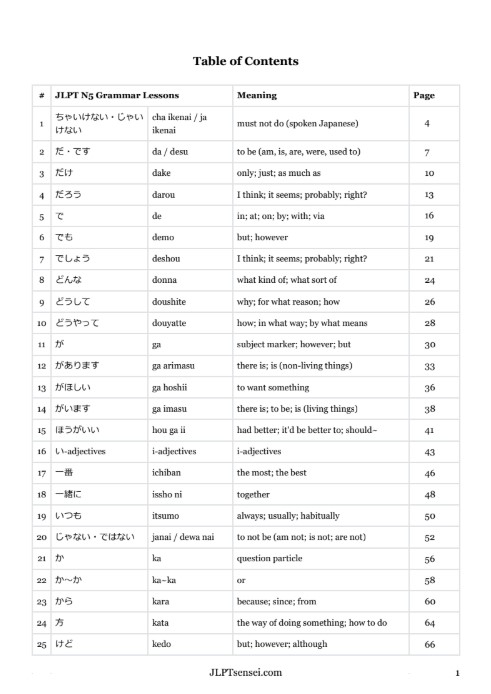
| # | JLPT N5 Grammar Lessons | Meaning | Page |
| 1 | ちゃいけない・じゃいけない (cha ikenai / ja ikenai) | must not do (spoken Japanese) | 4 |
| 2 | だ・です (da / desu) | to be (am, is, are, were, used to) | 7 |
| 3 | だけ (dake) | only; just; as much as | 10 |
| 4 | だろう (darou) | I think; it seems; probably; right? | 13 |
| 5 | で (de) | in; at; on; by; with; via | 16 |
| 6 | でも (demo) | but; however | 19 |
| 7 | でしょう (deshou) | I think; it seems; probably; right? | 21 |
| 8 | どんな (donna) | what kind of; what sort of | 24 |
| 9 | どうして (doushite) | why; for what reason; how | 26 |
| 10 | どうやって (douyatte) | how; in what way; by what means | 28 |
| 11 | が (ga) | subject marker; however; but | 30 |
| 12 | があります (ga arimasu) | there is; is (non-living things) | 33 |
| 13 | がほしい (ga hoshii) | to want something | 36 |
| 14 | がいます (ga imasu) | there is; to be; is (living things) | 38 |
| 15 | ほうがいい (hou ga ii) | had better; it’d be better to; should~ | 41 |
| 16 | い-adjectives (i-adjectives) | i-adjectives | 43 |
| 17 | 一番 (ichiban) | the most; the best | 46 |
| 18 | 一緒に (issho ni) | together | 48 |
| 19 | いつも (itsumo) | always; usually; habitually | 50 |
| 20 | じゃない・ではない (janai / dewa nai) | to not be (am not; is not; are not) | 52 |
| 21 | か (ka) | question particle | 56 |
| 22 | か〜か (ka ~ ka) | or | 58 |
| 23 | から (kara) | because; since; from | 60 |
| 24 | 方 (kata) | the way of doing something; how to do | 64 |
| 25 | けど (kedo) | but; however; although | 66 |
| 26 | けれども (keredo mo) | but; however; although | 68 |
| 27 | まだ (mada) | still; not yet | 70 |
| 28 | まだ〜ていません (mada ~te imasen) | have not yet | 72 |
| 29 | まで (made) | until ~; as far as ~; to (an extent); even ~ | 74 |
| 30 | 前に (mae ni) | before ~; in front of ~ | 76 |
| 31 | ませんか (masen ka) | would you; do you want to; shall we~ | 78 |
| 32 | ましょう (mashou) | let’s ~; shall we ~ | 80 |
| 33 | ましょうか (mashouka) | shall I ~; used to offer help to the listener | 82 |
| 34 | も (mo) | too; also; as well | 84 |
| 35 | もう (mou) | already; anymore; again; other | 86 |
| 36 | な-adjectives (na-adjectives) | na-adjectives | 89 |
| 37 | なあ (naa) | sentence ending particle; confirmation; admiration, etc | 91 |
| 38 | ないで (naide) | without doing ~; To do [B] without doing [A] | 93 |
| 39 | ないでください (naide kudasai) | please don’t do | 95 |
| 40 | なくていい (naku temo ii) | don’t have to | 97 |
| 41 | なくちゃ (nakucha) | must do; need to; gotta do | 99 |
| 42 | なくてはいけない (nakute wa ikenai) | must do; need to do | 102 |
| 43 | なくてはならない (nakute wa naranai) | must do; need to do | 104 |
| 44 | なる (naru) | to become | 106 |
| 45 | んです (n desu) | to explain something; show emphasis | 109 |
| 46 | ね (ne) | isn’t it? right? eh? | 111 |
| 47 | に (ni) | destination particle; in; at; on; to | 113 |
| 48 | にいく (ni iku) | go to do | 116 |
| 49 | にする (ni suru) | to decide on | 118 |
| 50 | に/へ (ni/e) | to (indicates direction / destination) | 120 |
| 51 | の (no) | possessive particle | 122 |
| 52 | のです (no desu) | to explain something; show emphasis | 124 |
| 53 | のが下手 (no ga heta) | to be bad at doing something | 127 |
| 54 | のが上手 (no ga jouzu) | to be good at | 129 |
| 55 | のが好き (no ga suki) | to like doing something | 131 |
| 56 | の中で[A]が一番 (no naka de [A] ga ichiban) | out of this group, [A] is best | 133 |
| 57 | ので (node) | because of; given that; since | 135 |
| 58 | を (o / wo) | object marker particle | 137 |
| 59 | をください (o kudasai) | please give me~ | 139 |
| 60 | しかし (shikashi) | but; however | 141 |
| 61 | すぎる (sugiru) | too much | 143 |
| 62 | たことがある (ta koto ga aru) | to have done something before | 146 |
| 63 | たい (tai) | want to do something | 148 |
| 64 | たり〜たり (tari ~ tari) | do such things as A and B | 151 |
| 65 | てある (te aru) | is/has been done (resulting state) | 153 |
| 66 | ている (te iru) | ongoing action or current state | 156 |
| 67 | てから (te kara) | after doing ~ | 162 |
| 68 | てください (te kudasai) | please do | 164 |
| 69 | てはいけない (te wa ikenai) | must not; may not; cannot | 166 |
| 70 | てもいいです (te mo ii desu) | is OK to…; is alright to…? may I…? | 168 |
| 71 | と (to) | and; with; as; connecting particle | 170 |
| 72 | とき (toki) | when; at this time | 172 |
| 73 | とても (totemo) | very; awfully; exceedingly | 174 |
| 74 | つもり (tsumori) | plan to ~; intend to ~ | 176 |
| 75 | は (wa) | topic marker | 178 |
| 76 | は〜より〜です (wa ~yori… desu) | [A] is more than [B] | 180 |
| 77 | はどうか (wa dou desu ka) | how about; how is | 182 |
| 78 | や (ya) | and; or; connecting particle | 184 |
| 79 | よ (yo) | you know; emphasis (ending particle) | 186 |
| 80 | より〜ほうが (yori ~hou ga) | [A] is more than [B] | 189 |
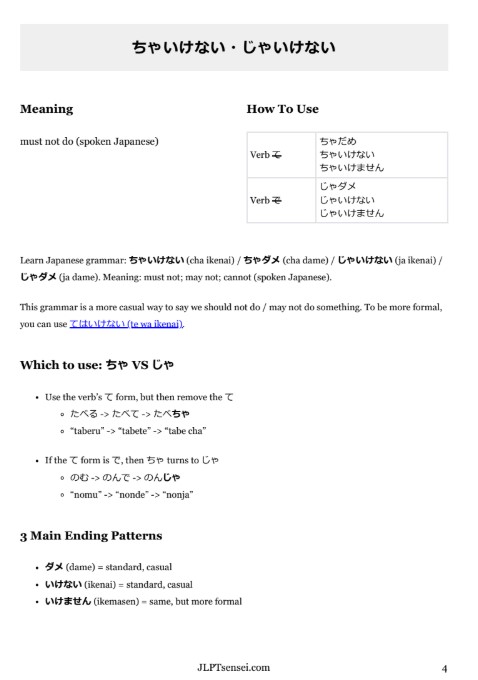
ちゃいけない・じゃいけない
Meaning
must not do (spoken Japanese)
How To Use
| Verbて | ちゃだめ |
| :— | :— |
| | ちゃいけない |
| | じゃだめ |
| | じゃいけません |
| Verbで | じゃだめ |
| | じゃいけない |
| | じゃいけません |
Learn Japanese grammar: ちゃいけない (cha ikenai) / じゃいけない (ja ikenai) / じゃだめ (ja dame). Meaning: must not; may not; cannot (spoken Japanese).
This grammar is a more casual way to say we should not do / may not do something. To be more formal, you can use てはいけない (te wa ikenai).
Which to use: ちゃ VS じゃ
- Use the verb’s て form, but then remove the て
- たべる -> たべて -> たべちゃ
- “taberu” -> “tabete” -> “tabe cha”
- If the て form is で, then ちゃ turns to じゃ
- のむ -> のんで -> のんじゃ
- “nomu” -> “nonde” -> “nonja”
3 Main Ending Patterns
- ・だめ (dame) = standard, casual
- ・いけない (ikenai) = standard, casual
- ・いけません (ikemasen) = same, but more formal
Example Sentences
- 寝る前にスマホを見ちゃだめよ。
neru mae ni sumaho o micha dame yo.
You shouldn’t look at your smartphone before going to bed. - ここはきけんなので、入っちゃだめだ。
koko wa kiken nano de, haiccha dame da yo.
This area is dangerous, so you’re not allowed to enter. - やっちゃいけないことをやっちゃった。
yaccha ikenai koto o yacchatta.
I did something I shouldn’t have… - 自信をなくしちゃいけません!
jishin o naku shicha ikemasen!
You mustn’t lose confidence! - そんなに授業をさぼっちゃだめよ。
sonna ni jugyou o saboccha dame yo.
You shouldn’t skip class so much. - 彼を信用しちゃいけない。
kare o shinyou shicha ikenai.
We cannot trust him. - 赤信号をむししちゃいけません!
aka shingou o mushi shicha ikemasen.
You must not ignore red lights!